Year-End Giving: Get Your Church Website Ready (Checklist)
For most churches, a startling share of the entire year’s giving arrives in December — roughly 30% of annual donations, with the final days of the month often the single biggest giving window of all. Some of it is generosity at Christmas; much of it is tax-motivated, racing the December 31 deadline. If your website and online giving aren’t ready and frictionless, that’s the one stretch of the year you can least afford to leave money on the table. Here’s how to get ready — start in the fall.
The year-end giving readiness checklist
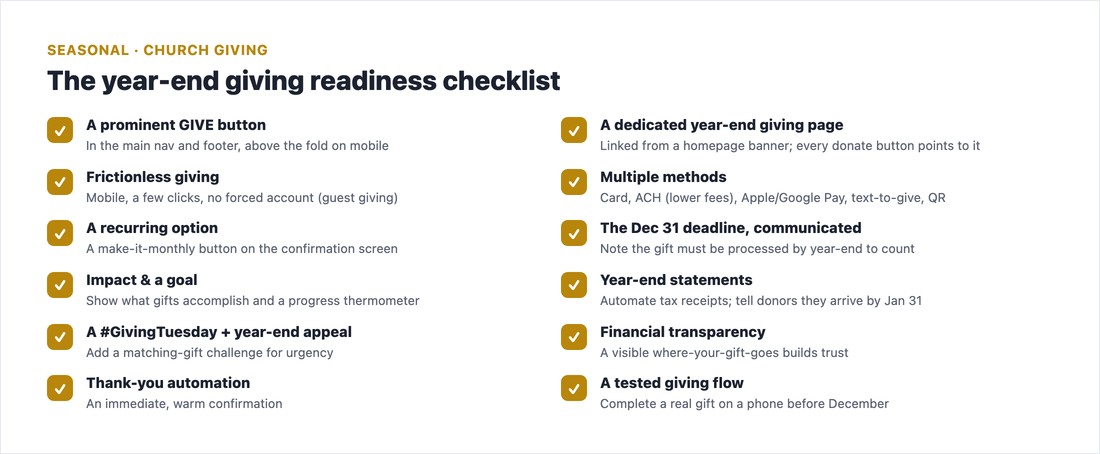
Start with a prominent GIVE button in your main navigation and footer — visible above the fold on mobile — and a dedicated year-end giving page linked from a homepage banner, with every “donate” button on the site pointing to it. Make the giving itself frictionless: mobile-first, a couple of clicks, and no forced account creation (allow guest giving). Offer multiple methods — card, ACH/bank transfer, Apple and Google Pay, text-to-give, and QR codes for in-service slides — and a recurring “make it monthly” option on the confirmation screen. Then show the vision: what gifts accomplish, a goal with a progress thermometer, and the financial transparency that builds the trust larger year-end gifts depend on. Our guide to setting up online giving covers the mechanics.
Steer the big gifts to ACH
Here’s a detail that matters most in December, when the largest gifts come in: ACH (bank transfer) fees are far lower than card fees. A card gift typically costs around 2.9% + $0.30, while ACH is roughly 1% — so on a $5,000 year-end gift that’s about $145 in card fees versus around $50 by bank transfer. Offer both, but gently steer large gifts toward ACH, and turn on the “cover the fees” option so donors can absorb the processing cost (most do). All the major church giving platforms — Tithe.ly, Pushpay, Subsplash, Planning Center — support recurring gifts, text-to-give, and fee coverage; see how the leaders compare in our Tithe.ly vs Pushpay guide.
The December 31 deadline (and receipts)
Communicate the year-end deadline clearly, because the timing rules trip people up. As a general guide: a card gift is deductible in the year the charge is made (so a December 30 gift your church doesn’t process until January 1 counts for the next year), and a mailed check must be postmarked by December 31. Plan to send year-end giving statements by January 31, and remember that any single gift of $250 or more needs a written acknowledgment. Tax rules vary by gift type and situation, so state the basics on your page and tell donors to consult a tax professional for their specifics — don’t give individualized tax advice.
The campaign timeline
- Early–mid November: set your goal, build the year-end page, draft your emails, and test the giving flow on a phone end to end.
- #GivingTuesday (early December): launch with a concrete impact story and, ideally, a matching-gift challenge for urgency.
- Mid-December: share a progress update and keep the matching push going.
- Final week / December 31: clear “give before midnight” deadline messaging, morning and late-day — the single biggest giving day of the year.
- January (by the 31st): send automated thank-yous and tax statements.
📄 Free download: The Year-End Giving Readiness Checklist (PDF) — the website-and-giving checklist, the frictionless-giving tactics, the deadline-and-receipts notes, and the November-to-January timeline.
The bottom line
December is the most generous month of the year, and a huge slice of it lands in the final days. The churches that capture it aren’t necessarily asking more — they’ve simply made giving effortless: a visible Give button, a clear year-end page, frictionless mobile giving with ACH and recurring options, an honest impact story, and a plan to thank and receipt donors promptly. Get your website ready in the fall, run it past our church website checklist, and your site will be ready when generosity peaks.
Frequently asked questions
When should a church start its year-end giving campaign?
Begin in early-to-mid November — set your goal, build the year-end giving page, and test the giving flow before demand arrives. Launch publicly on #GivingTuesday in early December, push again mid-month, and run clear “give before midnight” messaging in the final week, since the last days of December are the biggest giving window of the year.
How much church giving happens in December?
Roughly 30% of annual charitable donations come in December, and the final few days of the month are often the single biggest giving window of the entire year — much of it driven by donors giving before the December 31 tax deadline. That makes a ready, frictionless giving page genuinely high-stakes.
When is the deadline for a tax-deductible year-end gift?
Generally, a gift must be made by December 31 to count for that tax year. A card gift is treated as made on the date the charge goes through, and a mailed check must be postmarked by December 31. Rules vary by gift type — for stock, wire transfers, and individual situations, advise donors to consult a tax professional.
When should churches send year-end giving statements?
Send giving statements by January 31 so donors have them for tax filing. Any single gift of $250 or more requires a written acknowledgment from the church. Most church giving platforms can generate and send these statements automatically — set that up before year-end.
What’s the cheapest way to accept year-end gifts online?
ACH (bank transfer) is significantly cheaper than card — about 1% versus roughly 2.9% + $0.30 — which adds up on large year-end gifts. Offer both, steer big gifts toward ACH, and enable the “cover the fees” option so donors can absorb the processing cost. Compare giving platforms in our Tithe.ly vs Pushpay guide.