Church Website Builders
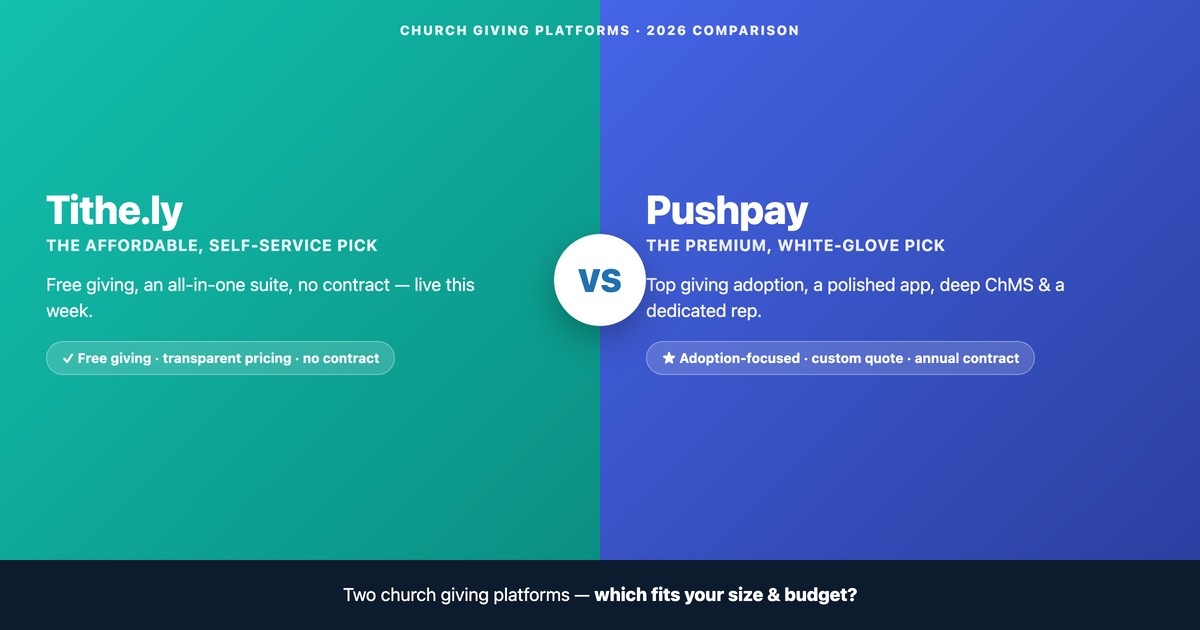
When a church shops for a digital giving platform, two names dominate the conversation: Tithe.ly, the affordable, self-service option whose giving is free, and Pushpay, the premium platform trusted by many of the country’s largest churches. They overlap on the essentials — online giving, a mobile app, member management — but they’re built for very different churches, and the right pick comes down to your size, your budget, and how much hand-holding you want.
This is an honest, platform-neutral comparison — we don’t sell either one. We’ll put them side by side on features and fees, demystify Pushpay’s famously private pricing, do the break-even math on whether its premium is worth it, and tell you plainly which fits your church. There’s a free comparison sheet to download at the end.
⏱️ The 30-second verdict: If your church is small to mid-size (roughly under 500), budget-conscious, or wants to be live this week with no sales call, Tithe.ly is almost always the right call — its giving is free and its pricing is transparent. If you’re a large or multisite church that will use a polished custom app, deep member-management, and a dedicated rep — and giving adoption is a strategic priority — Pushpay’s premium can be worth it. Per-transaction fees are nearly identical, so this is really a question of subscription cost versus white-glove service.
Tithe.ly is built around being affordable and easy to start. Its giving platform is free — you only pay processing fees — and the broader suite (a website builder, church management, and a branded app) is priced low and sold without a contract. You sign up, set it up yourself, and go live in days. It’s used by tens of thousands of mostly small and mid-size churches for exactly that reason.
Pushpay is the enterprise option. It’s known for a highly polished giving and app experience engineered to maximize giving adoption — the share of your congregation that actually gives digitally — backed by deep analytics, a robust church management system (Church Community Builder), native streaming (Resi), and a dedicated account rep. You don’t sign up online; you book a demo, get a custom quote, and commit to an annual contract. It’s the platform behind many of the largest churches in the country. Pushpay was taken private by investment firms in 2022, and the “premium, sales-led” posture reflects that enterprise focus.
Churches often fixate on processing fees when comparing giving platforms — and here, that’s the wrong place to look, because the two are essentially tied. Both charge roughly 2.9% + $0.30 per card or debit gift and about 1% + $0.30 for ACH/bank transfers, and both let donors optionally cover those fees. A fraction-of-a-percent difference on card rates is noise.
The real cost difference is the platform subscription and the contract. Tithe.ly’s giving carries no monthly fee at all; Pushpay layers a platform subscription on top and locks it into a multi-year agreement. So the honest question isn’t “which has lower fees” — it’s “is Pushpay’s premium subscription worth what it adds?” We’ll answer that with real numbers below.
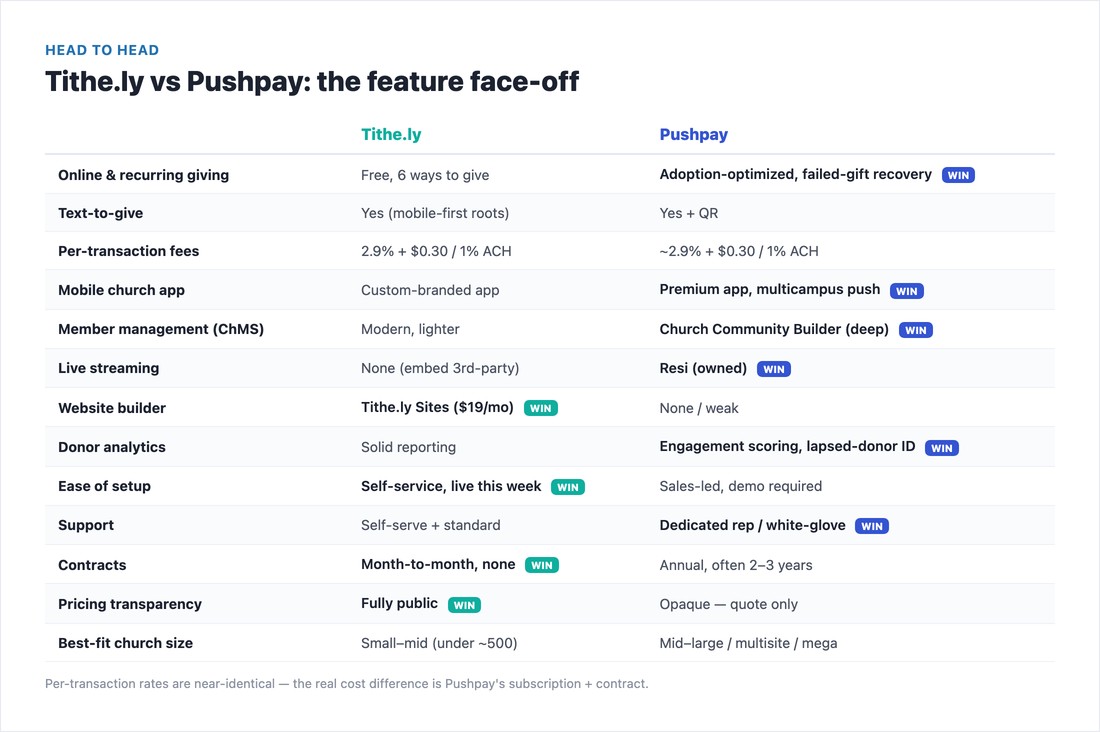
Pushpay wins on depth and polish. Its giving flow is obsessively optimized for adoption (prefilled amounts, fast repeat gifts, automatic recovery of failed recurring payments), its custom app is richer — especially for multisite churches — and it brings a genuinely enterprise-grade church management system in Church Community Builder, native live streaming through Resi, and predictive donor analytics that flag lapsing givers. If you have staff to use those tools, they’re powerful.
Tithe.ly wins on accessibility. It’s transparent, it’s cheap, there’s no contract, you can launch it yourself this week, and it includes something Pushpay essentially doesn’t — a real website builder (Tithe.ly Sites). It also scores higher on customer satisfaction: on Capterra, Tithe.ly holds about 4.7 stars across nearly 700 reviews versus Pushpay’s 4.2 across roughly 180, with the widest gap on “value for money.” For most churches, Tithe.ly does enough, for far less.
Two rows in that table deserve a closer look, because they’re where larger churches feel the difference most. On the mobile app, both offer a custom-branded church app, but Pushpay’s is noticeably more refined — dynamic, campus-aware home screens, rich push notifications, and a companion app for leaders — which matters a great deal when you’re coordinating several campuses and thousands of attendees. Tithe.ly’s app covers the core needs (sermons, giving, events, groups) well for a single-site or small church, just without the same depth.
On member management, the gap is philosophical. Pushpay’s church management system is Church Community Builder, a long-established, enterprise-grade platform with deep tools for groups, process queues, check-in, and reporting — powerful if you have staff to run it. Tithe.ly’s ChMS is lighter and more modern, designed so a volunteer or small team can manage people, groups, and follow-up without a training course. Bigger churches with dedicated administrative staff tend to value Church Community Builder’s depth; smaller churches usually find Tithe.ly’s simplicity is the feature, not a limitation.
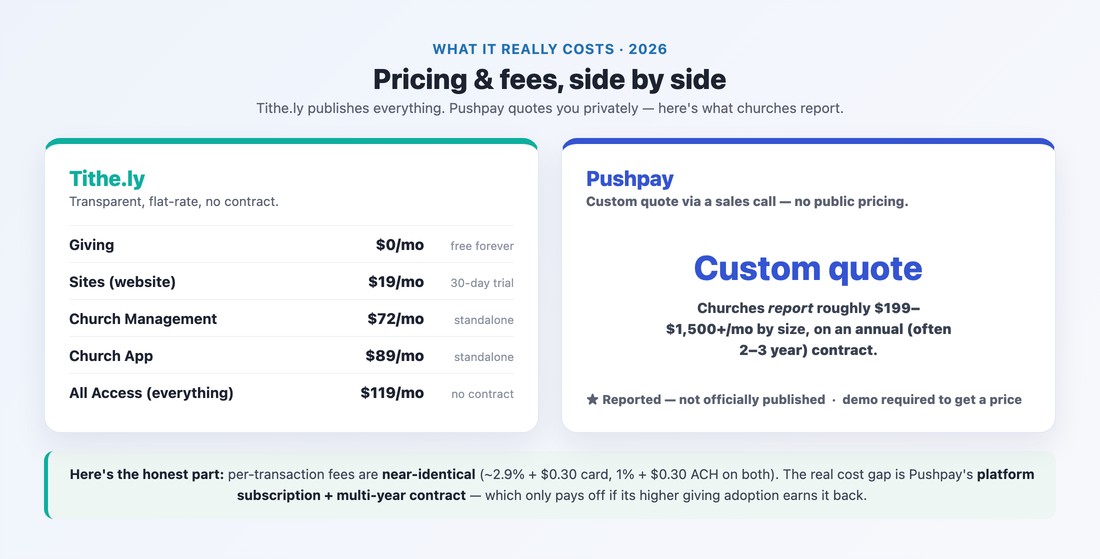
Tithe.ly publishes everything. Giving is free, the website builder is $19/month, church management is $72/month, the app is $89/month, and the All Access bundle that includes everything is $119/month — all with no contract and a 30-day free trial. You know your cost before you ever talk to anyone.
Pushpay does not publish pricing. You have to book a demo and request a custom quote, and the agreement is typically an annual — often two- to three-year — contract. That opacity is itself a meaningful factor: it makes apples-to-apples budgeting hard and signals an enterprise sales motion. From churches that have shared their quotes, the reported range runs from a few hundred dollars a month at the small end up past a thousand for larger churches bundling giving with the app and church management. Treat those as reported figures, not official rates — your actual number depends on size and what you bundle, and there may be a setup fee. The takeaway isn’t a precise price; it’s that Pushpay is a budgeted, contracted line item, while Tithe.ly is a known, cancel-anytime cost.
How you start with each platform tells you a lot about who it’s for. With Tithe.ly, you create an account, follow the setup yourself, and can be collecting gifts within a day or two — there’s a 30-day free trial on the paid tools and no one to convince. That self-service model is ideal for a church without dedicated tech staff and a pastor who’d rather not sit through a sales call.
Pushpay is the opposite by design. You request a demo, a representative walks your team through the platform, and onboarding is guided — which is genuinely valuable for a large church migrating thousands of donor records and standing up multiple campuses, where a dedicated rep and a structured rollout reduce risk. The trade-off is time and commitment: you can’t simply try it tonight, and you’re signing a contract. Neither approach is wrong; they match different church realities. A 120-person church wants to move today; a 4,000-person church wants a partner and a migration plan. Match the onboarding model to which of those you are.
Pushpay’s entire premium rests on one argument: a smoother, faster, better-designed giving experience gets more of your congregation giving digitally — and giving more consistently — which more than pays for the higher cost. The company markets claims like double-digit lifts in recurring giving and “six-second” gifts. These are vendor claims, so weigh them with healthy skepticism, but the underlying logic is sound: friction kills recurring gifts, and a platform that removes friction can genuinely move the needle for a large church.
The key word is large. An adoption lift is only worth a premium if the dollars it unlocks exceed what the premium costs — and that math depends entirely on how much your church gives digitally in the first place. Which brings us to the decision.
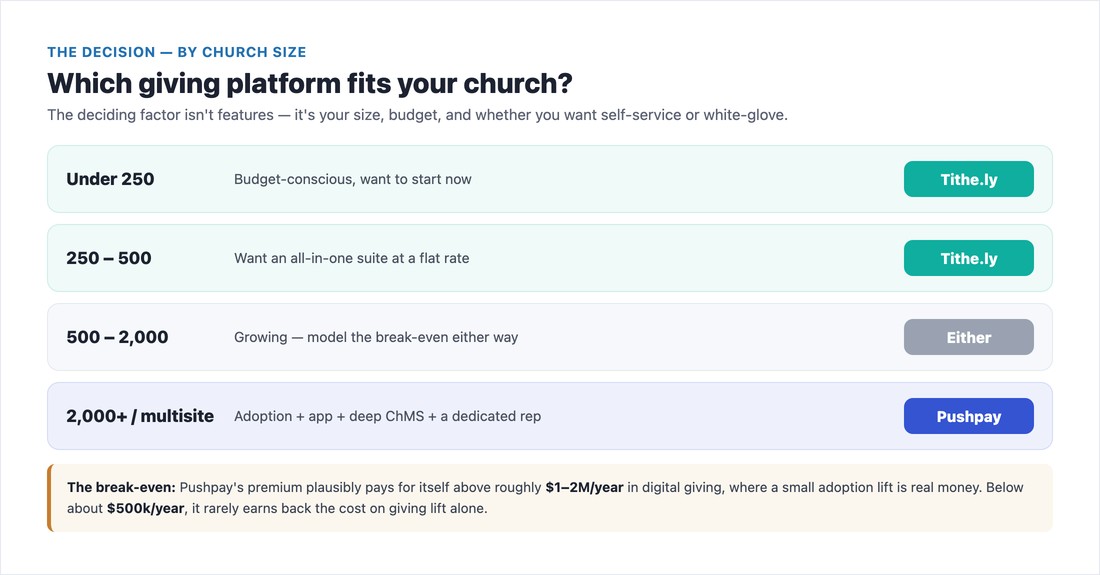
Here’s the break-even logic in plain terms. Because per-transaction fees are the same, Pushpay’s premium is essentially its annual subscription. For that premium to pay for itself, the extra giving its better adoption produces has to exceed that subscription. A church receiving $1.5–2 million a year in digital gifts only needs a small percentage lift for the math to work — so Pushpay’s premium can genuinely earn its keep. A church receiving under $500,000 a year would need an implausibly large lift to break even, so the premium rarely pays off on adoption alone. Most churches in the middle should model it honestly against their own giving total rather than assume.
Pick Tithe.ly if you’re under ~500 attendees (especially under 250), budget-conscious, want to launch without a sales call, need an all-in-one suite — including a website — at one predictable rate, and value no contract. For the large majority of churches, this is the pragmatic, lower-risk choice.
Pick Pushpay if you’re a large or multisite church, your digital giving is high enough that a few points of adoption is real money, and you want a best-in-class app, deep member management, native streaming, and a dedicated rep — and you have both the budget and the tolerance for an annual contract. It’s an enterprise tool, and it shines for enterprise-scale churches.
Tithe.ly and Pushpay aren’t the only options, and the best fit might be a third platform. Subsplash sits between the two — a premium app-and-giving platform broader than Tithe.ly but generally more accessible than Pushpay. Planning Center Giving is a strong pick if your church already lives in the Planning Center ecosystem, with simple per-transaction pricing. And Givebutter works well for very small or budget-zero churches with its free, tip-supported model. If giving is one piece of a bigger website project, our guide to setting up online giving on a church website covers how any of these embed into your site, our church website builders roundup compares the platforms more broadly, and Squarespace vs Tithe.ly weighs Tithe.ly’s website side against a design-first builder.
📄 Free download: The Tithe.ly vs Pushpay Comparison Sheet (PDF) — the full feature face-off, pricing and fees, and the cost-by-size break-even on two printable pages for your team or board.
Review data lines up with the picture above. On Capterra, Tithe.ly carries roughly 4.7 stars from nearly 700 reviewers, while Pushpay sits around 4.2 from about 180. The most telling detail is where the gap is widest: value for money, where Tithe.ly scores well into the 4s and Pushpay lands in the mid-3s, with a similar split on the cost of support. That’s exactly what you’d expect — churches rarely complain that Pushpay isn’t capable; the friction is price and contract. Pushpay’s own reviews skew toward larger churches that praise its app and adoption results, which is consistent with it being an enterprise tool that delivers for enterprise-scale churches.
The lesson isn’t “Tithe.ly is better because it’s rated higher” — a free tool will almost always win on value-for-money scoring. It’s that the satisfaction data reinforces the size logic: smaller churches feel Pushpay’s cost as a burden, while larger churches feel it as a worthwhile investment. Read reviews from churches your size, not just the average, and weigh them against what your church will actually use.
Tithe.ly and Pushpay are both excellent at what they’re built for — they’re just built for different churches. Tithe.ly is the right default for most: free giving, transparent pricing, no contract, and enough features to serve a small or mid-size church well, plus a website builder Pushpay can’t match. Pushpay earns its premium at scale: for large and multisite churches where giving volume is high and a polished, adoption-optimized experience translates into real dollars, the cost can pay for itself. Start from your church’s size and giving total, not from which name sounds more impressive — and don’t overpay for enterprise tooling you won’t use, or underinvest if you’ve genuinely outgrown the basics.
Neither is universally better — it depends on your church’s size and budget. Tithe.ly is the better fit for most small and mid-size churches: free giving, transparent pricing, no contract, and a website builder. Pushpay is better for large and multisite churches that want a premium app, deep member management, and dedicated support, and whose giving volume is high enough to justify the cost.
Pushpay doesn’t publish pricing — you book a demo and get a custom quote, typically on an annual (often two- to three-year) contract. Churches report figures ranging from a few hundred dollars a month at the small end to over a thousand for larger churches bundling giving with the app and church management, sometimes plus a setup fee. Treat these as reported ranges, not official rates.
Tithe.ly Giving is free — there’s no monthly fee, and you only pay standard per-transaction processing fees (about 2.9% + $0.30 on cards, 1% + $0.30 on ACH). The broader suite is paid: the website builder is $19/month, church management $72/month, the app $89/month, or everything in the All Access bundle for $119/month, all with no contract.
Effectively yes. Both charge roughly 2.9% + $0.30 per card gift and about 1% + $0.30 for ACH/bank transfers, and both offer a donor-covered-fees option. The meaningful cost difference between them isn’t processing fees — it’s Pushpay’s platform subscription and multi-year contract versus Tithe.ly’s free giving and no-contract pricing.
Yes. Pushpay is sold through a sales process and typically requires an annual contract, often a two- to three-year commitment for the best pricing. Tithe.ly, by contrast, is month-to-month with no contract, which is part of why it’s easier for smaller churches to adopt.
Roughly when your church receives more than about $1–2 million a year in digital giving. At that scale, even a small lift in giving adoption can exceed Pushpay’s subscription cost, so the premium can pay for itself. Below about $500,000 a year, the premium rarely earns back its cost on adoption alone, so most smaller churches are better served by Tithe.ly.

Church Website Builders
Church Website Builders
Church Website Builders
10 complete church website templates, MIT licensed. Browse every demo freely; we will email you whichever folder you want.
All templates