Church Website Builders
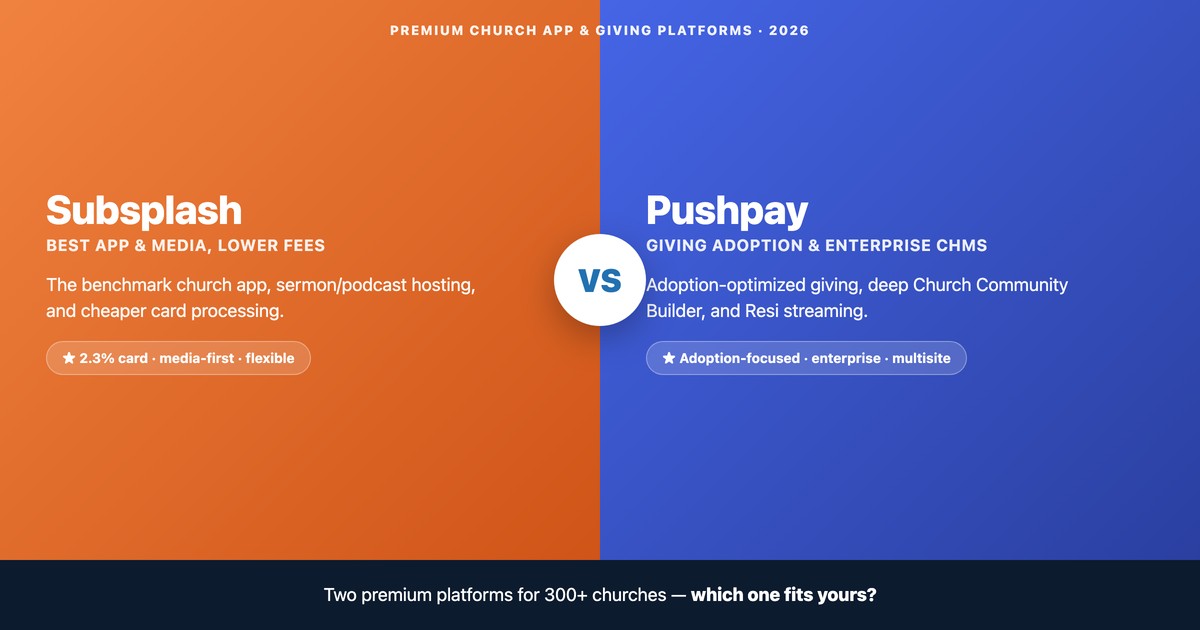
If your church has outgrown a basic giving button and a DIY website, the conversation usually narrows to two premium platforms: Subsplash and Pushpay. Both are high-end, app-first systems built for larger churches, both bundle a custom mobile app with giving and member tools, and both quote you privately rather than posting a price. So this isn’t a cheap-vs-expensive fight — it’s two strong options with genuinely different strengths, and the right pick comes down to what your church values most.
This is an honest, platform-neutral comparison — we sell neither. We’ll put them head to head on the app, giving, media, and member management, demystify their pricing and the very real difference in their fees, and tell you plainly which fits which kind of church. There’s a free comparison sheet at the end.
⏱️ The 30-second verdict: Choose Subsplash if media is a ministry, you want the benchmark church app, and you’d like lower card-processing fees and a more flexible contract. Choose Pushpay if growing digital giving is your top priority and you need enterprise-grade member management (Church Community Builder), broadcast streaming (Resi), and white-glove support for a large or multisite church. Both are premium and quote-based — so the decision is about fit, not price tags.
Subsplash built its reputation on the best custom church app in the business and a media engine to match — sermon hosting, automatic podcast distribution, video libraries, and one-click publishing to web, app, and podcast at once. If your weekly content is central to your ministry, that’s its gravity. It rounds that out with giving, events, groups, a maturing church management system, and lower processing fees. Subsplash was acquired by Roper Technologies in 2025, which signals stability and scale behind the product.
Pushpay built its reputation on giving. Its whole platform is engineered to lift giving adoption — the share of your congregation that gives digitally and consistently — with a famously fast checkout, prefilled amounts, and automatic recovery of failed recurring gifts. It pairs that with a deep enterprise church management system (formerly Church Community Builder) and Resi, its broadcast-grade streaming platform (sold separately). It’s the system behind many of the largest churches in the country, and it’s built for that scale.
Since the mobile app is the headline product for both, it’s worth a closer look. Subsplash’s app is widely regarded as the design benchmark in church tech — polished, deeply customizable, and content-first, with support for CarPlay, Android Auto, and TV apps so your sermons and worship follow people into the car and living room. It’s the natural home for a church whose app is really a media hub. Pushpay’s app is excellent too, but giving-first by design: the fastest path to a gift, prefilled amounts, and a companion app for leaders, with engagement features layered on. Both are genuinely good; the difference is emphasis — Subsplash leads with content and experience, Pushpay leads with conversion and giving behavior. Picture how your congregation will actually use the app week to week, and the right one usually becomes obvious.
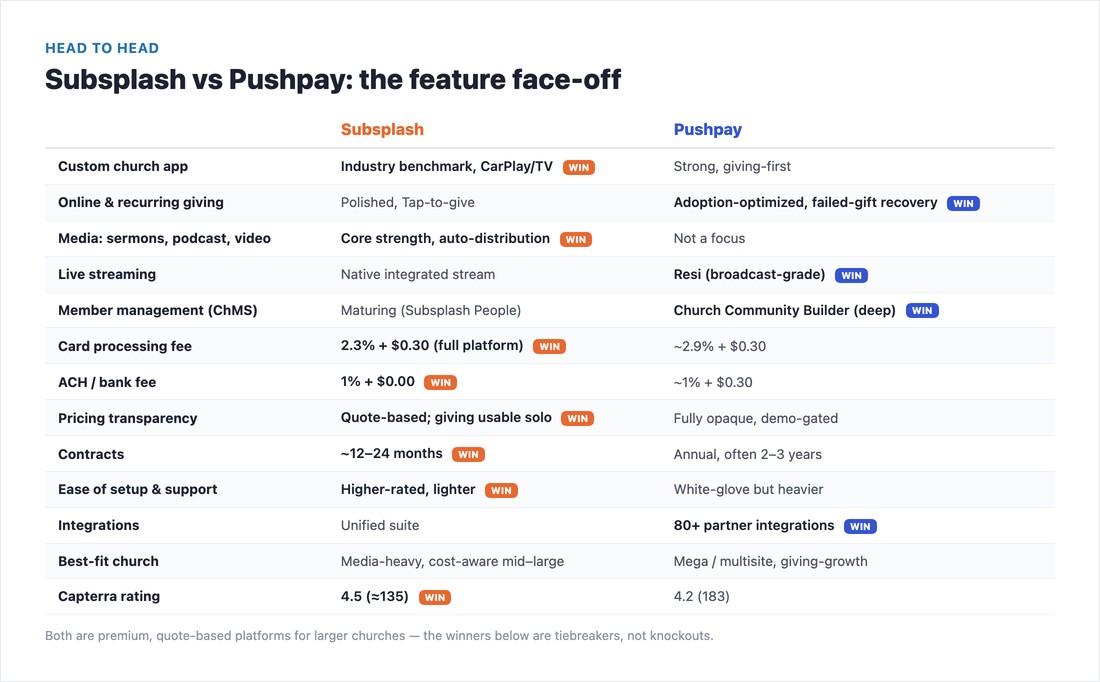
Subsplash takes the app, media, fees, and flexibility. Its app is the design benchmark (down to CarPlay and TV apps), its media tooling is unmatched, its card fees are lower, its contracts are shorter, and it scores higher on customer satisfaction — about 4.5 stars on Capterra versus Pushpay’s 4.2, with the widest gaps on value and support. Pushpay takes giving, ChMS depth, streaming, and integrations. Its giving is engineered for adoption, Church Community Builder is a more powerful member-management system than Subsplash’s, Resi is broadcast-grade, and it advertises the broadest integration ecosystem. For a single-site, content-heavy church, Subsplash usually wins; for a multisite giving operation, Pushpay’s depth earns its place.
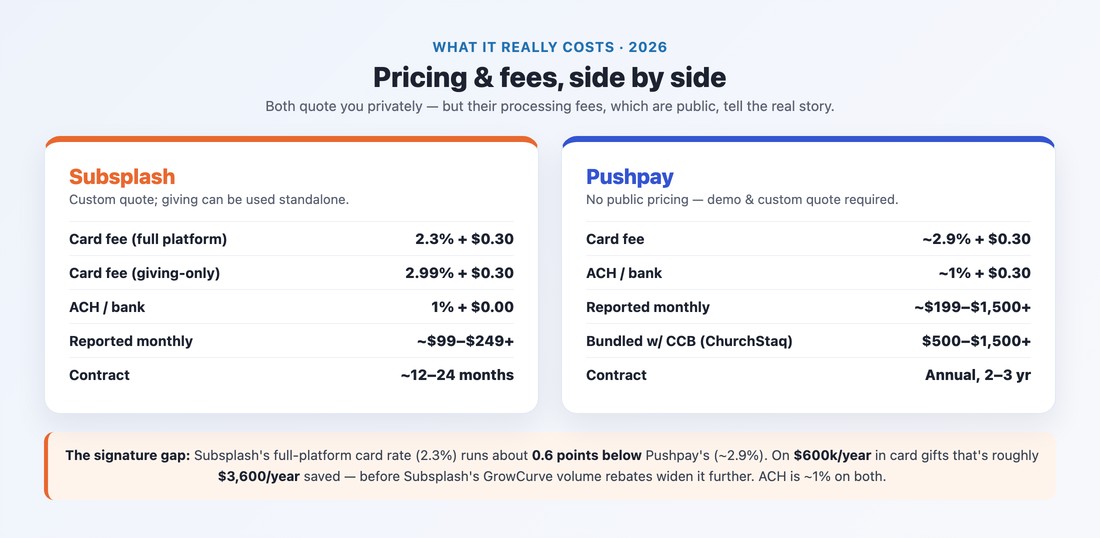
Here’s where the two genuinely diverge on cost. On its full platform, Subsplash charges about 2.3% + $0.30 per card gift (it’s 2.99% if you use giving on its own), while Pushpay runs around 2.9% + $0.30. ACH/bank gifts are roughly 1% on both. That ~0.6-point card difference sounds small, but on real giving volume it adds up — and Subsplash’s GrowCurve program lowers its effective rate further as your giving grows.
Here’s the gap in dollars, comparing annual card-fee cost at the headline rates (ACH is similar on both, so this is the card slice only):
| Annual card giving | Subsplash (2.3%) | Pushpay (2.9%) | You save |
|---|---|---|---|
| $250,000 | ~$5,750 | ~$7,250 | ~$1,500/yr |
| $500,000 | ~$11,500 | ~$14,500 | ~$3,000/yr |
| $1,000,000 | ~$23,000 | ~$29,000 | ~$6,000/yr |
Two honest caveats. First, weigh this against the monthly subscription difference — a full Pushpay setup bundled with Church Community Builder typically costs more per month than Subsplash, so the fee savings are part of a bigger total-cost picture, not the whole story. Second, donors can cover fees on both platforms, which softens the impact either way. Still, for a church moving serious money through cards, the fee gap is a real, recurring advantage for Subsplash.
If there’s one place Pushpay clearly leads, it’s the church management system. Pushpay owns Church Community Builder, a mature, enterprise-grade platform with deep tools for groups, process queues, check-in, multisite structures, and reporting — the kind of depth a large, multi-ministry church leans on daily. Subsplash has been investing here too: its Subsplash People ChMS is real and improving (with AI-assisted tools), but it’s still shallower than Church Community Builder’s enterprise feature set. If member management and complex reporting are central to how you operate, that gap matters; if you mostly need solid people and giving records, Subsplash’s is sufficient and simpler.
Two areas have shifted recently and are worth weighing. On live streaming, Pushpay owns Resi, a broadcast-grade platform with a reputation for rock-solid, resilient encoding — the kind of reliability a large church with serious AV invests in. Subsplash offers solid integrated streaming with on-screen giving and chat prompts, which is plenty for most churches but isn’t pitched as broadcast infrastructure. If streaming uptime and production quality are mission-critical, that’s a point for Pushpay; if you want streaming that simply works inside your app, Subsplash covers it.
Both have also leaned into AI. Subsplash added sermon-to-content AI (turning a single message into clips, posts, and study material) and AI tools across its people and giving data. Pushpay has added an AI layer aimed at pastoral care and giving insights. These features are young on both sides, so don’t pick a platform for the AI alone — but they signal active investment, which matters for a multi-year commitment. On that note, Subsplash’s 2025 acquisition by Roper Technologies and Pushpay’s private-equity ownership both point to stable, well-funded products rather than startups that might vanish.
Neither company posts a public price — both require a demo and a custom quote, which makes apples-to-apples budgeting hard. From what churches report, Subsplash tends to land in the low hundreds per month by configuration, and giving can even be used on its own with no monthly fee, on a roughly 12–24 month term. Pushpay reportedly runs from a couple hundred a month for giving up past a thousand when bundled into its ChurchStaq suite (giving, ChMS, apps, and Insights — Resi streaming is sold separately), typically on an annual — often two- to three-year — contract. Treat all of these as reported ranges, not official rates: your real number depends on size, products, and negotiation. The structural takeaway is that Subsplash is generally the more flexible and lower-fee commitment, while Pushpay is the heavier, more enterprise one.
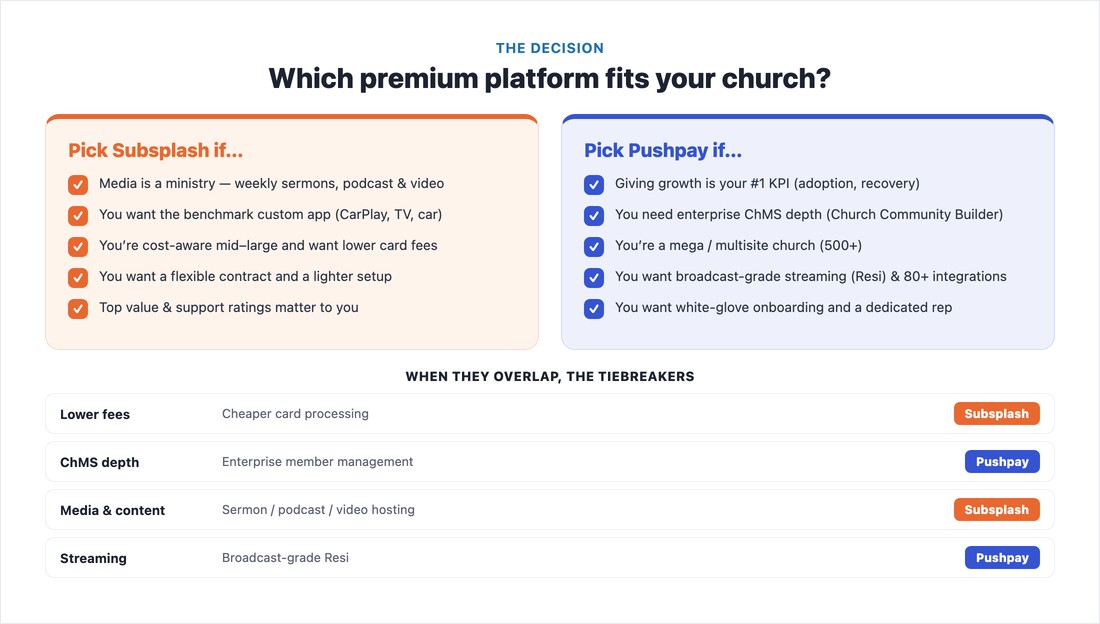
Pick Subsplash if media is a ministry — you publish sermons, a podcast, and video every week and want best-in-class hosting and the benchmark app; if you’re a cost-aware mid-to-large church that values lower card fees and a more flexible contract; or if top satisfaction and support ratings sway you. Pick Pushpay if growing digital giving is your number-one metric and you’ll use its adoption tooling and analytics; if you need the enterprise depth of Church Community Builder; or if you’re a mega or multisite church that wants broadcast-grade streaming, the broadest integrations, and a dedicated rep — and the budget and multi-year contract aren’t blockers.
When they genuinely overlap — both are excellent premium suites for churches of a few hundred and up — let the tiebreakers decide: lower fees and media depth tilt Subsplash; ChMS depth and broadcast streaming tilt Pushpay.
No platform is all upside, and an honest comparison names the trade-offs. Subsplash’s weak spot is the same as most app-first platforms: its website builder is functional but not a design showcase, so a church that wants a truly standout website may still pair it with a dedicated builder. Its member-management system, while improving, doesn’t yet match enterprise depth, and like any all-in-one it creates lock-in across the suite. Pushpay’s recurring knocks are cost and contracts — its opaque, demo-gated pricing and multi-year commitments are exactly what churches flag in reviews, where its value and support scores trail Subsplash’s. It’s also overkill for a small church, and its website tooling is minimal. Knowing these going in keeps your expectations honest and your negotiation sharper.
If you’re a smaller church and the premium price of either gives you pause, you’re probably not the target customer for Subsplash or Pushpay yet — and that’s fine. Tithe.ly offers an all-in-one suite (website, giving, and a church app) from around $119/month with no contract, which serves churches under a few hundred well; see our Tithe.ly vs Pushpay comparison for that end of the market. Planning Center is another modular option worth a look. And our full Subsplash review goes deeper on that platform on its own. The point: don’t buy enterprise tooling before you’ve outgrown the affordable tier.
📄 Free download: The Subsplash vs Pushpay Comparison Sheet (PDF) — the full feature face-off, the card-fee gap in dollars, and the who-should-pick decision on two printable pages for your team.
Subsplash and Pushpay are both excellent — they just lead with different strengths. Subsplash is the content-and-value pick: the best app, unmatched media tools, lower fees, and a friendlier contract, ideal for a media-driven church that wants premium quality without the heaviest commitment. Pushpay is the giving-and-enterprise pick: adoption-optimized giving, the deepest member management, and broadcast streaming, ideal for a large or multisite church where growing giving and running complex operations justify the premium. Decide from your church’s actual priorities — your weekly content and fees, or your giving growth and member-management depth — and either one will serve you well.
Neither is universally better — they lead with different strengths. Subsplash wins on the custom app, media tools, lower card fees, and contract flexibility, and rates higher for customer satisfaction. Pushpay wins on giving-adoption tooling, enterprise member management (Church Community Builder), broadcast streaming (Resi), and integrations. Subsplash suits media-driven and cost-aware churches; Pushpay suits large, multisite, giving-focused churches.
Yes. Pushpay offers a custom-branded church app built around its giving and engagement tools, plus a separate app for church leaders. It’s strong and giving-focused. Subsplash’s app is generally considered the design benchmark in the category, with deeper media features and support for CarPlay, Android Auto, and TV apps.
Subsplash. On its full platform, Subsplash charges about 2.3% + $0.30 per card gift versus Pushpay’s roughly 2.9% + $0.30, with ACH around 1% on both. On $500,000 of annual card giving that’s roughly $3,000 a year in savings, and Subsplash’s GrowCurve rebates can widen the gap. Weigh it against the monthly subscription difference for the full cost picture.
Both require a demo and a custom quote — neither publishes pricing. Churches report Subsplash landing in the low hundreds per month by configuration (with giving usable standalone at no monthly fee), and Pushpay ranging from a couple hundred for giving up past a thousand when bundled with Church Community Builder and Resi, typically on a multi-year contract. Treat these as reported ranges, not official rates.
Subsplash is an all-in-one church platform best known for its custom mobile app and media tools — sermon hosting, podcast distribution, and video — alongside online giving, events, groups, a website builder, and a church management system. Churches use it to publish content everywhere at once, collect giving, and engage members through a branded app.
Usually not yet. Both are premium platforms aimed at churches of a few hundred and up. A small church is typically better served by an affordable all-in-one like Tithe.ly (website, giving, and app from around $119/month with no contract) until it outgrows that tier and needs the deeper app, giving-adoption, or member-management tools these platforms provide.

Church Website Builders
Church Website Builders
Church Website Builders
10 complete church website templates, MIT licensed. Browse every demo freely; we will email you whichever folder you want.
All templates