Church Website Builders
Nucleus Church is a newer entrant in the church website builder market, positioning itself as the design-forward option for churches that want a modern, visitor-focused online presence. Founded by people with church communication backgrounds, Nucleus takes a different approach than older platforms — it prioritizes the first-time visitor experience above all else.
But newer doesn’t always mean better. We evaluated Nucleus across design quality, features, ease of use, pricing, and how it stacks up against established alternatives. Here’s our honest assessment.
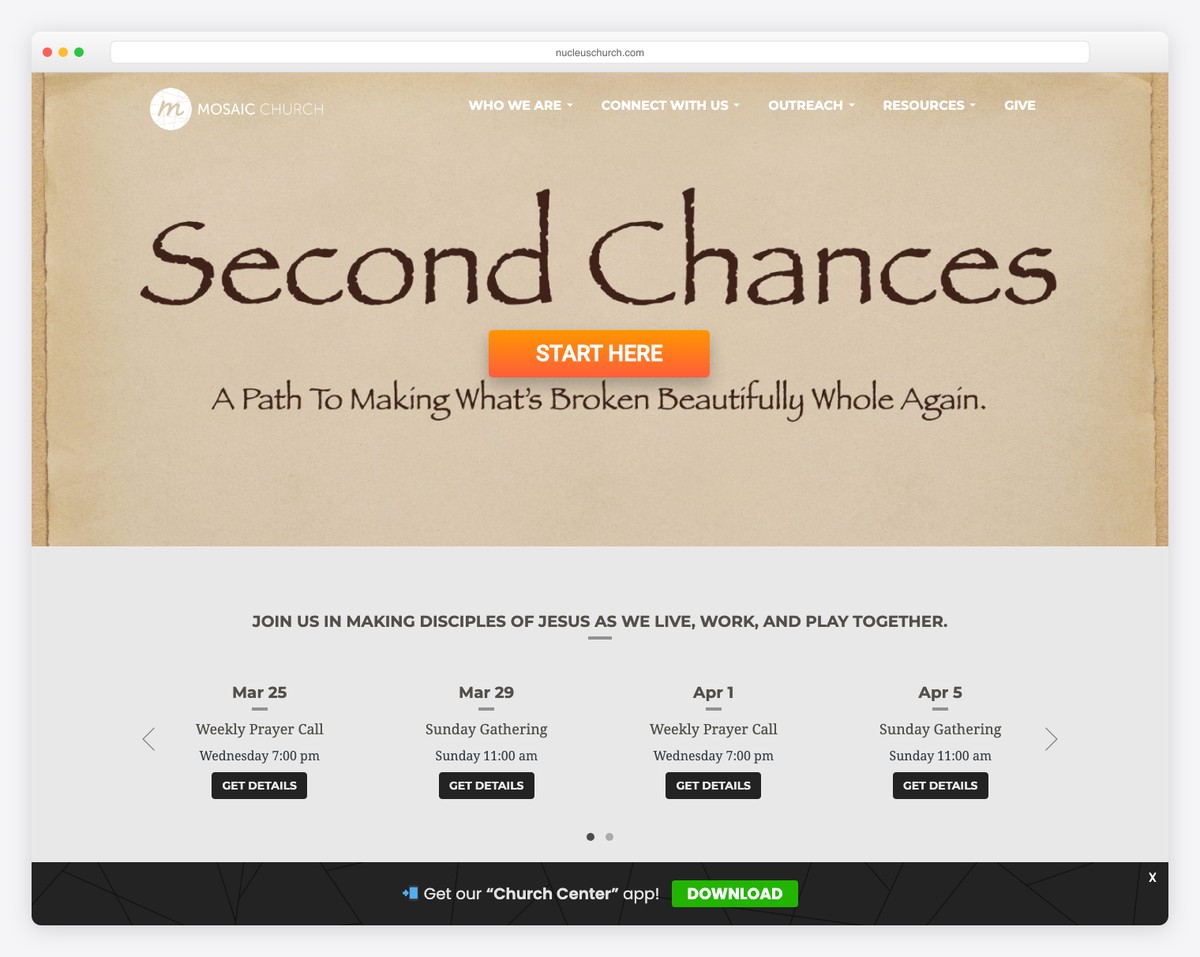
Nucleus Church delivers beautiful, conversion-focused websites that prioritize the first-time visitor experience. The design quality is strong, and the platform’s philosophy is sound. But premium pricing, a smaller user base, and the inherent risks of a newer platform make it a harder recommendation than more established options like Tithe.ly or Squarespace. If you value design and visitor conversion above all else and are comfortable with a newer platform, Nucleus is worth evaluating.

Nucleus takes design seriously. Their websites look clean, modern, and professionally designed — comparable to The Church Co in visual quality. Templates use contemporary design patterns: generous whitespace, thoughtful typography, hero sections with intentional imagery, and layouts that guide the eye naturally from welcome message to call-to-action.
The design philosophy is built around the idea that your church website’s primary job is to help first-time visitors take their next step — usually visiting on Sunday. Every template is structured around this conversion funnel, which is refreshing in a market where many church website builders produce sites that look like internal communication hubs rather than welcoming front doors.
This is Nucleus’s defining philosophy, and it shapes everything about the platform. The default homepage structure follows a proven pattern: welcome message, service times, “Plan Your Visit” call-to-action, brief church description, and featured content. The navigation is simplified — fewer menu items, clearer labels, and prominent action buttons.
Many church websites bury the visitor experience under layers of content designed for existing members. Nucleus flips this — the visitor experience is the default, and member-focused content is secondary. This aligns with the homepage formula we recommend for all church websites.
Nucleus includes built-in sermon management that handles audio, video, and series organization. Sermon pages are well-designed with series artwork, speaker information, and a clean playback interface. The sermon experience is more polished than what most church builders offer, though it doesn’t match the depth of Subsplash‘s media management.
Nucleus walks you through the setup process with a structured onboarding flow. Rather than dropping you into a blank editor, it guides you through: choosing your style, adding your church information, uploading photos, setting up key pages, and configuring your homepage. For churches without web experience, this guidance reduces the intimidation of starting from scratch.
All Nucleus templates are built mobile-first, which matters because the majority of church website visitors are on phones. The mobile experience isn’t an afterthought — it’s the primary design target, with desktop being the responsive adaptation. Text is readable, buttons are tappable, and navigation works smoothly on small screens.
Nucleus is a younger company compared to Tithe.ly, Subsplash, or Squarespace. That brings inherent risks: will the company be around in five years? Will they continue to invest in new features? What happens if they’re acquired or shut down? These aren’t hypothetical concerns — the church tech space has seen platforms come and go.
Established platforms have years of track record, large customer bases, and financial stability that newer companies can’t yet demonstrate. If long-term stability is important to your church (and it should be), this is a factor worth weighing.
Nucleus now publishes flat pricing, and credit where due — it’s simple: Nucleus Web is $99/month ($1,188/year), and Nucleus Complete, which adds giving, the communications engine, and media, is $199/month. There’s a 15-day free trial, no contracts, and you can cancel anytime.
The catch is the number itself: $99/month for a website-and-sermons product is five times Tithe.ly Sites at $19/month and more than three times Squarespace’s entry plan. Nucleus is betting you’ll pay for its visitor-conversion philosophy and design quality. For a cost comparison across platforms, see our church website cost guide.
The base Nucleus Web plan covers websites and sermons. Giving, communications, and media exist — but only as the $199/month Complete bundle, which includes Nucleus Giving (1.9% card rate, 25-cent bank gifts). Even then there’s no church management system and no mobile app, so you’ll still pair Nucleus with external tools for those functions — managing multiple platforms and potentially losing the integration benefits of an all-in-one solution.
Fewer churches use Nucleus, which means less community knowledge, fewer tutorials, fewer reviews, and a smaller pool of people who can help if you have issues. When you’re evaluating a platform, the size of the user community matters — it affects how quickly you can find answers and how confident you can be in the platform’s longevity.
| Feature | Nucleus | Tithe.ly | Squarespace |
|---|---|---|---|
| Design quality | Very good | Good | Excellent |
| Visitor-focused design | Core philosophy | Good | You design it |
| Sermon management | Built-in, polished | Built-in, adequate | Manual (blog) |
| Online giving | Complete plan only | Built-in (best-in-class) | Built-in (Donation block) |
| Church management | Not built-in | Available (Tithe.ly People) | Not available |
| Mobile app | Not available | Available (paid) | Not available |
| Pricing transparency | Published | Published | Published |
| Platform maturity | Newer | Established | Very established |
| Community size | Small | Large | Very large |
Nucleus Church has a clear vision — make church websites that look great and convert visitors — and they execute it well. The design quality is above average for church-specific builders, and the visitor-focused philosophy is sound. But the combination of premium pricing, limited features beyond websites, and the inherent risks of a newer platform make it a conditional recommendation.
If you’ve evaluated Tithe.ly and Squarespace and found them lacking in design quality or visitor focus, Nucleus is worth a closer look. But for most churches, those established platforms offer better overall value with less risk. Check our church website builders comparison for the full picture.
Nucleus publishes flat pricing: Nucleus Web is $99/month ($1,188/year), and Nucleus Complete — which adds giving, the communications engine, and media — is $199/month. There’s a 15-day free trial, no contracts, and you can cancel anytime.
Not on the base plan — Nucleus Web covers the website and sermon experience. Nucleus now offers its own giving product, Nucleus Giving (1.9% card rate, 25-cent bank gifts), included in the $199/month Complete plan. On the base plan you can embed a separate platform for online giving — Tithe.ly Giving is a popular choice to pair with Nucleus.
Yes. Nucleus’s onboarding process is designed to help churches transition from other platforms. Your content (text, images, sermons) will need to be re-entered, as automated migration from other church platforms isn’t standard. Nucleus may offer migration assistance as part of their onboarding — ask during your demo.
Nucleus has better design quality and a stronger visitor-focus philosophy. Clover Sites has a more established track record and better ecosystem integration (giving, ChMS). If design matters most, Nucleus wins. If simplicity and ecosystem integration matter more, Clover is the safer choice. For most churches, however, Tithe.ly or Squarespace are better than either option.
This is a valid concern with any hosted platform, but especially newer ones. If Nucleus were to close, you would need to rebuild your website on another platform. Your content (text, images) could be saved, but the design and structure would need to be recreated. Ask Nucleus about their data export options and contingency plans during evaluation. This risk exists with every hosted builder, but it’s higher with smaller companies.

Church Website Builders
Church Website Builders
Church Website Builders
10 complete church website templates, MIT licensed. Browse every demo freely; we will email you whichever folder you want.
All templates